
Obion Release Dates Are Distinct
A release date can refer to several events. Tennessee FOIL uses the exact public label Sentence End Date. It is TDOC's current sentence calculation, not an appointment at a prison gate. A release-eligibility date identifies when consideration may begin under the applicable law. A parole-hearing date identifies a proceeding. A Board grant records action that may still be subject to programs and release-plan approval. The actual release date records the physical custody event.
A pretrial detainee at Obion County Jail does not have a sentence-based end date. Release can depend on bond, a dismissal, a plea, sentencing, or another court order. Even after one case permits release, another warrant, detainer, consecutive sentence, state pickup, or federal hold can continue custody. A sentenced person has a calculation, but it can move as lawful credits and later events are recorded.
Community supervision can also continue after physical release. Parole may begin before sentence expiration, while probation can be imposed directly or after split confinement. A supervision-end date is therefore not the same as the day someone left jail or prison.
Find an Obion Inmate Release Date
Choose the source by custody type. Use TDOC's Felony Offender Information Lookup for a person serving or formerly connected to a state felony sentence. FOIL accepts first and last name with optional race and aliases, or TOMIS/TDOC ID or SID. Complete the CAPTCHA, match identifiers, and open the details record. Read current status before dates: incarcerated means state custody, parole means community release under conditions, probation means court-ordered supervision, and inactive means no active TDOC record.
For an Obion County Jail sentence, call the jail and obtain the current sentence calculation or credit ledger. Compare it with the signed judgment through the limited Obion court inquiry and the proper clerk division. The Sheriff's main number is 731-885-5832; the separately published jail number is 731-885-0277. Records hours are not posted, so call before visiting 1 Law Lane in Union City. For a pretrial case, follow the court order and confirm the physical result with the jail.
- Identify whether the person is pretrial, locally sentenced, or under a TDOC sentence.
- Match the person in FOIL or the jail record with more than a name.
- Copy the exact status and every date label, including Sentence End Date.
- Compare the sentence, offenses, and consecutive or concurrent structure.
- Check parole eligibility, hearing status, holds, and later court orders.
- Recheck the live source and request the actual release record.
Federal custody requires the BOP locator or the agency holding the record. A federal prisoner housed temporarily at Obion County Jail may not follow the local sentence-credit path.
Obion FOIL Sentence End Date
The supported Tennessee FOIL term is Sentence End Date, not “Projected Release Date.” The TDOC FOIL overview says public information may include photo, custody or supervision status, location, offenses, sentence data, parole-hearing status, and release information. FOIL covers current and former felony offenders connected to TDOC. It does not cover every short local stay, misdemeanor, or dismissed charge at Obion County Jail.
After matching the person, record each sentence and offense. Note whether consecutive or concurrent structure appears, then record eligibility information, hearing status, location, status, and Sentence End Date. Also save the date of access. A future value should be described as TDOC's current calculation. A past value paired with inactive status supports the end of the active TDOC record, but a formal archived discharge entry remains the better proof of event type and exact date.
The state sentence-credit source shown below is T.C.A. § 41-21-236.
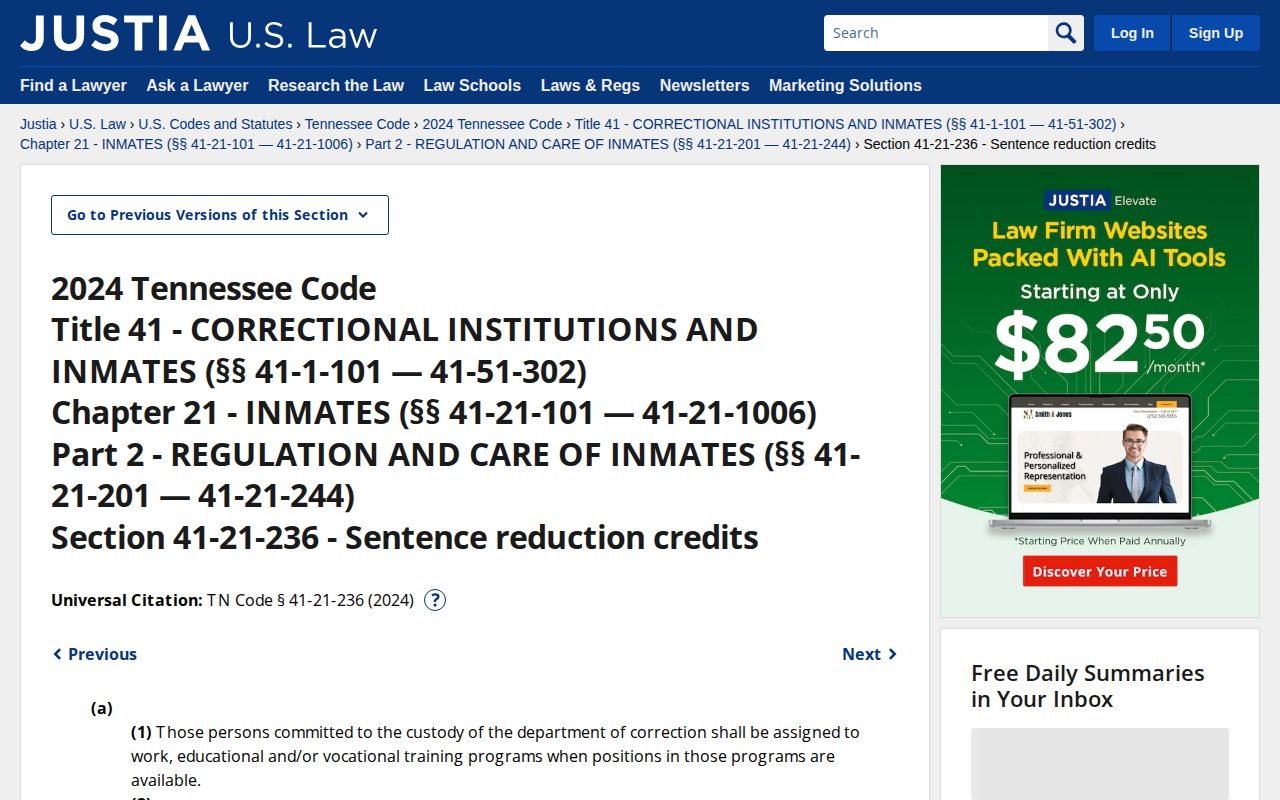
The statute helps explain why a calculation can change, but only the custodian can apply the law, judgment, and credit record to a named person.
Tennessee Credits Affect Obion Release Dates
T.C.A. § 41-21-236 authorizes one through sixteen credit days for each month served in covered circumstances. Up to eight may be tied to good behavior and up to eight to satisfactory program performance. Awards are monthly, discretionary, and documented. A disciplinary offense can prevent a month's award, and major infractions can lead to credit removal. Maximum-security or punitive-segregation status can affect eligibility. Those are record-based decisions, not numbers that can be safely estimated from a public sentence alone.
The effect of state credits also depends on offense and sentence timing. For offenses before July 1, 2024, or a sentence shorter than two years for an offense on or after that date, credits may reduce the sentence calculation as the statute provides. For sentences longer than two years for offenses on or after July 1, 2024, credits may advance parole eligibility without altering sentence expiration. That distinction prevents the end-date field from being treated as the earliest possible community release.
Local provisions differ. Section 41-21-236(d) applies specified good-behavior credits to felony offenders serving at least one year in a local jail, substituting the jail administrator for the warden. Subsection (e) allows up to eight days per month of presentence credit for good behavior when supported by written administrator documentation or recommendation. It is not automatic. For local misdemeanors, subsection (f) uses a sentencing-court percentage from 30 through 100 percent in ten-point steps and limits how credits reduce that percentage.
Note: A maximum statutory credit is not a promised award, and the public sentence alone cannot reveal the person's earned-credit ledger.
Obion Release Dates and 85%
Tennessee does not have a sound general rule that every inmate serves 85 percent. T.C.A. § 40-35-501 contains offense-specific, range-specific, and date-specific provisions. Traditional offender ranges can involve 30, 35, 45, or 60 percent eligibility points. Other offenses have special rules. Public Chapter 988 of 2022 created 100-percent service provisions for one group and limited the effect of credits for another so that parole eligibility cannot be advanced by more than 15 percent.
That limited 15-percent credit effect is the source of the “85%” shorthand. Reaching that threshold is an eligibility point, not automatic release. The Board may deny parole, or a grant may remain subject to conditions. For offenses subject to 100-percent service, credits may have program or privilege uses without reducing required confinement under the applicable provision. The offense, commission date, judgment, offender range, precise statutory subsection, and amendments must all be checked.
The official eligibility provision can be read at T.C.A. § 40-35-501.
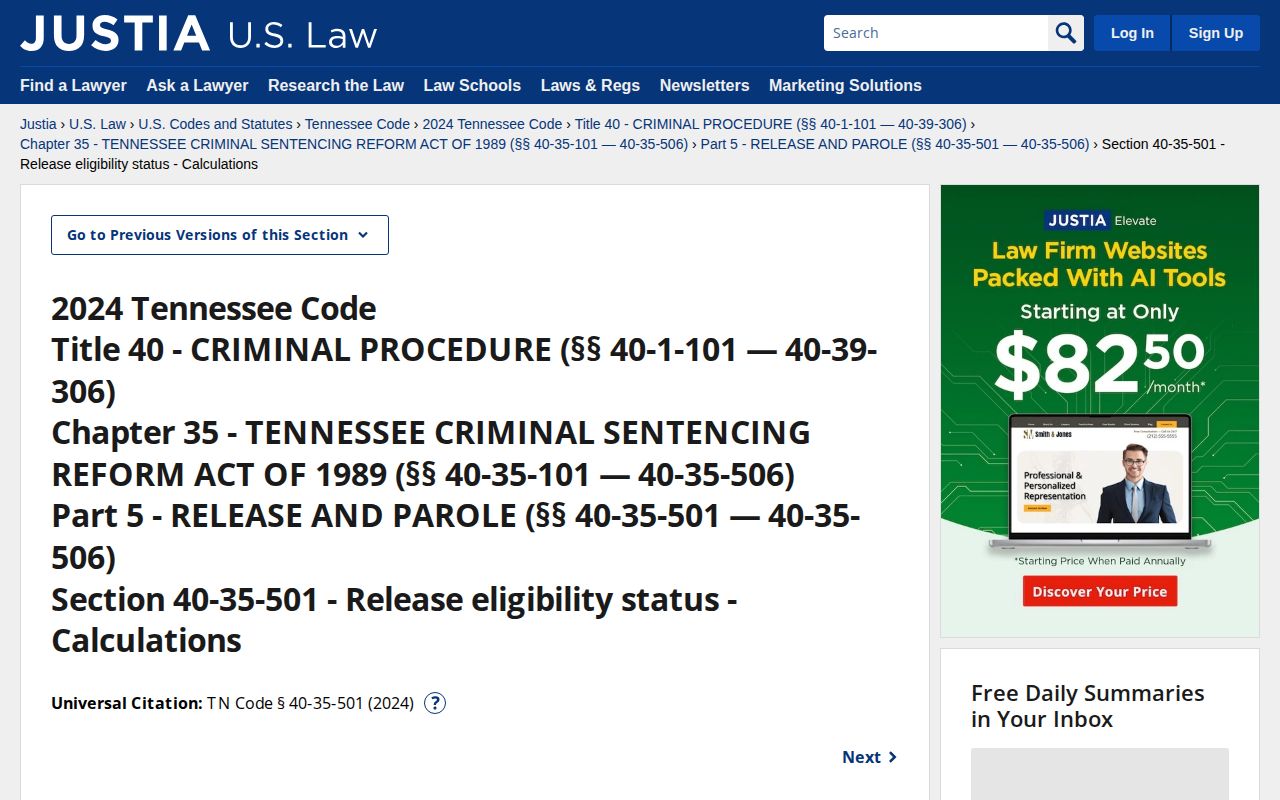
The statutory view supports a cautious eligibility reading and does not replace TDOC's dated calculation or the actual release entry.
Why Obion Release Dates Change
A saved future date can become stale. Credit awards and removals, discipline, a new judgment, revocation, or administrative correction can alter the current calculation. Consecutive terms run one after another; concurrent terms run at the same time. A court's later order may change how time is credited. Another authority's hold can prevent the person from entering the community even when the first custodian closes its own record.
| Change | Effect on the date or event | Best record |
|---|---|---|
| Monthly credits | May change calculation or eligibility as law permits | TDOC or jail credit ledger |
| Disciplinary action | Can block or remove credits | Custodian disciplinary and calculation records |
| New court order | Can alter credits, sentence, or release authority | Signed judgment or order |
| Consecutive sentence | Adds another term before full expiration | Judgment and sentence computation |
| Parole action | May allow community release before expiration | Board action plus TDOC release record |
| Violation or revocation | May return a supervised person to custody | Court, Board, and TDOC records |
| Detainer or hold | Can cause transfer instead of community release | Jail record and successor agency search |
| Recalculation | Corrects the future date when inputs change | Dated custodian calculation |
A changed FOIL date is not proof of misconduct. It can follow lawful administrative or court updates. Compare access dates and ask TDOC Records Management for the relevant record when the reason is important.
Obion Work Credits Need Records
Obion County's local computation has a distinctive program rule. The Sheriff's official jail description says eligible work and in-house program participants may receive one day off the sentence for each day worked. That statement does not publish an individual formula, maximum, forfeiture process, or appeal route. It also does not apply to every person held at the jail.
The jail houses county, state, and federal prisoners. Their physical location does not identify which sentencing system controls the release date. A county sentence may involve local program credits, presentence jail credit, a court-set service percentage, and holds. A state sentence uses TDOC calculations and state law. Federal custody follows federal records. Determine the legal custodian first.
Ask the Obion County Jail for the dated sentence-credit ledger or calculation and compare it with the signed judgment. If program participation is relevant, request the record showing how credited days were entered. Neither the one-day-for-one-day local description nor the newer state credit law can be converted into a personal date without those records.
This is the core of Obion's release-date computation quirk: two genuine credit frameworks exist, yet neither supports a safe estimate from a name and sentence length alone.
Work-release participation adds another point of confusion. Obion's program transports eligible participants to a worksite and returns them to the jail, where they remain in custody. A work shift is not the actual release event. Credit for approved activity may affect a local calculation, but the person's place in the program does not establish parole, probation, or a walkout date. Ask how each credit was posted and whether later discipline, a hold, or a court order changed the total.
Confirm an Obion Release Date
Recheck the live FOIL record close to the expected event. For a local sentence, call the jail and ask whether the current calculation changed. Then compare any court order or parole action. A future date does not account for every last-minute hold, transfer, or administrative event.
Tennessee VINE can add a time-sensitive notice for release, transfer, or escape. The Obion County VINELink Release Check explains the exact-person match, delivery choices, and four-digit phone PIN. An alert should still be confirmed with the reporting agency. The actual release record should show the custody exit date, time, and disposition.
For a full named-person lookup across jail, court, state, and federal sources, use the Obion County released inmates search. Preserve each source's own label. Sentence End Date, eligibility date, hearing date, release date, and supervision end date are separate facts and should remain separate in any notes or request.
If an expected date passes without a confirmed release, do not assume an error. Check for a transfer, a second case, a detainer, a parole condition, or a recalculated sentence. Request a dated response from the current custodian. That record will show whether the earlier date changed or whether another authority took custody at the end of the first agency's term.