
Obion County VINELink Coverage
Tennessee's custody notification program is Tennessee Statewide Automated Victim Information and Notification, usually called TN SAVIN. The Tennessee Sheriffs' Association TN SAVIN page states that all 95 sheriff agencies participate. That statewide participation makes VINE a relevant channel for an Obion County Jail custody event. The Sheriff's Inhouse Inmates page also directs local users to MobilePatrol and FOIL. TDOC directs users to VINE for state offenders. Access is free and confidential through VINELink, the mobile channel, and the statewide phone service.
Coverage does not merge all custody into one record. An Obion County Jail result represents data supplied for that local booking. A TDOC result represents state custody or supervision data. A person leaving sheriff custody could be transferred to TDOC, the U.S. Marshals Service, another county, or another authority. The word shown for the event controls the reading. “Transfer” must not be rewritten as “release.”
The official Tennessee selection and result flow can be reviewed through VINELink.
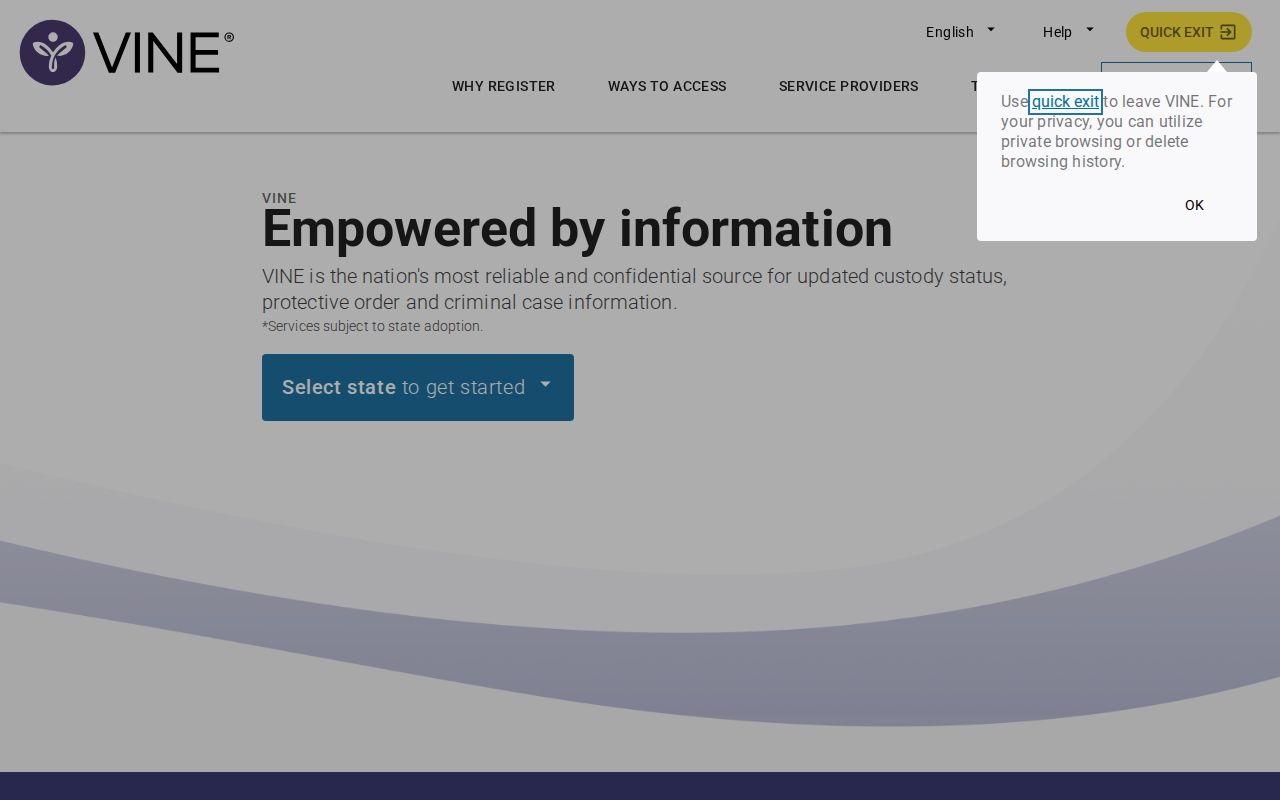
The screen is a starting point for a specific-person match, not an Obion County historical release list.
Search One Obion County Inmate
Begin by identifying which agency likely holds the person. For an Obion booking, select Tennessee and use the offender or custody search. Enter the name or booking number if available. For a state offender, use the name or offender ID. VINELink names and search choices can vary with the source record, so read the labels on the live form instead of assuming every field will appear.
A shared name is not a match. Compare the reporting agency, age or birth information, identifying number, and any available location. Registration should follow that check. A wrong-person alert can produce a false conclusion when someone with a similar name has a custody change.
- Open VINELink and choose Tennessee.
- Select the offender or custody search offered for the record type.
- Enter the full name, booking number, or offender ID that is known.
- Compare every available identifier and the reporting agency.
- Open only the record that matches the intended person.
- Save the source agency and status before registering for notices.
If no match appears, try verified spelling and aliases. Then contact the jail or search TDOC FOIL when a felony state sentence may be involved. No result does not prove release.
Booking number and offender ID are especially useful because VINE may hold records from more than one Tennessee contributor. A person who has both a local booking and a TDOC history can have records tied to different source agencies. Do not combine their dates or statuses. The local result may end with transfer to state custody while the state result remains incarcerated. Conversely, a later TDOC parole event does not supply the earlier Obion County Jail release timestamp. Each custodian preserves its own event.
When the search returns several plausible people, stop before choosing notifications. Compare every public identifier that the result supplies, then confirm the agency connection through a booking record or FOIL. If the source still cannot be matched, call Obion County Jail at 731-885-0277. The Sheriff's main line is 731-885-5832, and its web contact page can route a Corrections message. Hours for records service are not posted, so a phone check should come before a visit.
Obion VINELink Release Fields
A VINELink record is designed for current custody information and time-sensitive notice. The available fields depend on the contributor. Read them together. Status without agency context is incomplete, and an agency event does not establish what a second agency did next. For a released result, request the custodian's actual date, time, and disposition entry when exact proof is needed.
| Field | What it means |
|---|---|
| Name and identifier | Helps distinguish the intended person from a similar name. |
| Reporting agency | Identifies the jail or corrections source whose custody changed. |
| Custody status | Shows the contributor's current status wording. |
| Facility or location | Names the location reported for that record when supplied. |
| Event type | May distinguish release, transfer, escape, or another change. |
| Event date or time | Records when the contributor transmitted or supplied the event. |
| Notification choices | Lists the delivery methods available for that record. |
A displayed “release” means the reporting agency ended that custody. It does not exclude an immediate hold, warrant, state pickup, federal move, or another booking. A still-in-custody record should be read through the live source agency. A released person may later drop from a roster even though a saved VINE event remains useful evidence of what was transmitted.
Note: Preserve the exact event word and reporting agency because release, transfer, and escape require different follow-up checks.
Register Obion County Release Alerts
Open the correct record before choosing notifications. The system may offer phone, text, email, or app delivery. Availability can differ by record and channel. Multiple phone numbers or email addresses may be registered. Use a direct line instead of a switchboard, keep contact details current, and protect any PIN as private information.
Tennessee's VINE instructions say a phone registrant creates a four-digit PIN. When an automated call arrives, listen to the message and enter that PIN to confirm receipt. Unanswered calls may continue for at least 24 hours or until someone confirms the notice. A forgotten PIN can be reset by calling and choosing zero for an operator. The PIN confirms receipt of a call; it does not prove the person's identity or freedom.
- Match the exact person and reporting agency.
- Choose the notification option on that record.
- Select phone, text, email, or app if offered.
- Enter and confirm the contact details for each channel.
- Create the four-digit phone PIN when prompted.
- Enter the PIN during an automated call to stop repeat delivery.
- Update the registration when a phone number or email changes.
For help by telephone, TN SAVIN lists 1-888-868-4631, also written as 1-888-TN-VINE-1. The TTY line is 1-866-847-1298.
Redundant delivery can be useful when the live record offers it. A phone call gives an audible notice and requires PIN confirmation, while text, email, or an app may preserve a written timestamp. Those timestamps show when a message arrived. They do not change the meaning of the source event. Keep the alert private, record the contributor, and make the follow-up call to that contributor.
Obion's Statewide Notification Layer
Obion County does not use a separately branded county notification network in the research. Its distinctive local layer is the statewide TN SAVIN system, backed by participation from every Tennessee sheriff. That structure lets a person search through one statewide channel while still requiring close attention to the agency that supplied each record.
VINE Courts is different. The Tennessee VINE Courts information describes notices tied to case events. A case notice may help explain a hearing, order, or other court action. It is not the jail-door transaction and does not certify that physical release took place. Static sources did not establish that every Obion court division or case type participates, so use it only where the live system or clerk confirms coverage.
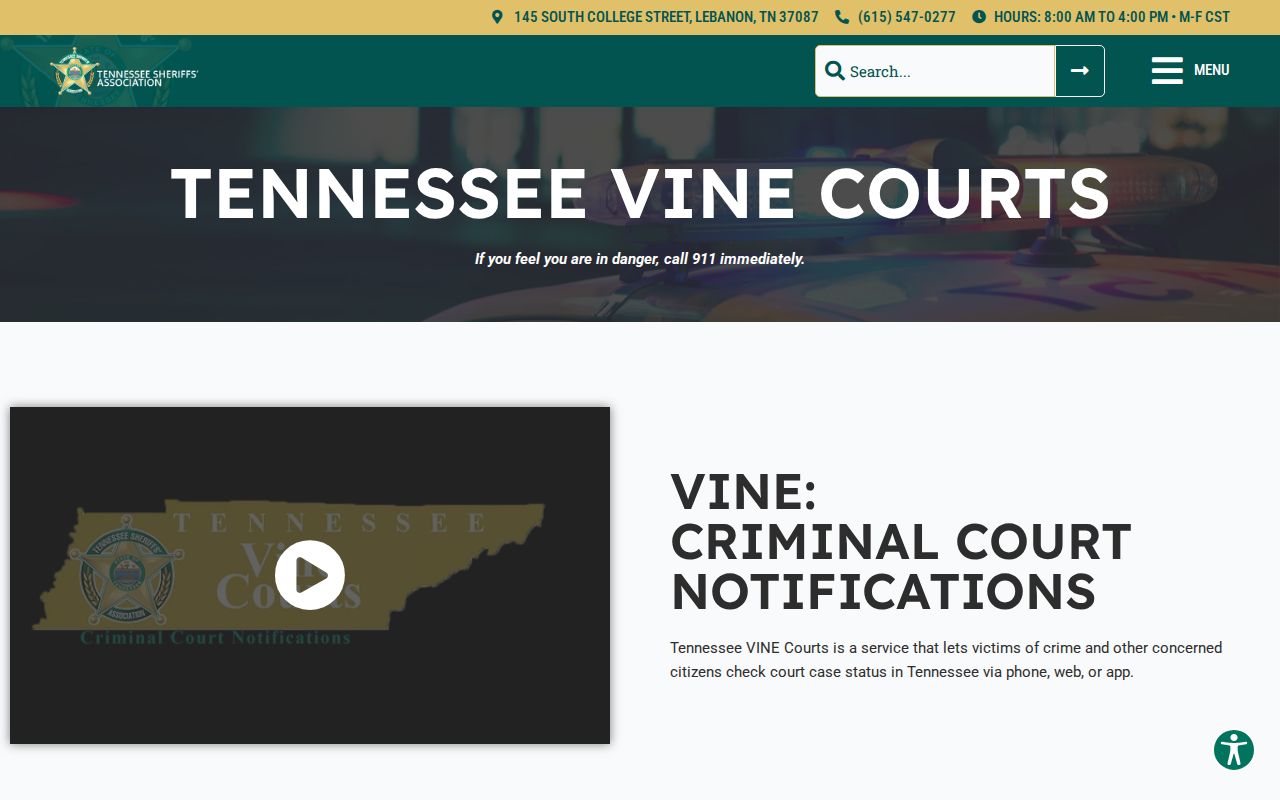
This separate case-event stream should be compared with custody VINE, the jail record, and the signed court order rather than treated as a substitute for them.
TDOC VINE and Obion Releases
TDOC participates in VINE for state offenders, which matters because Obion County Jail houses a mix that includes state prisoners. A state offender can be searched by name or offender ID. Yet VINE and TDOC FOIL answer different parts of the question. VINE sends a custody event. FOIL can show incarcerated, parole, probation, or inactive status along with state sentence and release information.
Use the TDOC VINE service announcement to identify the official state notification channel.
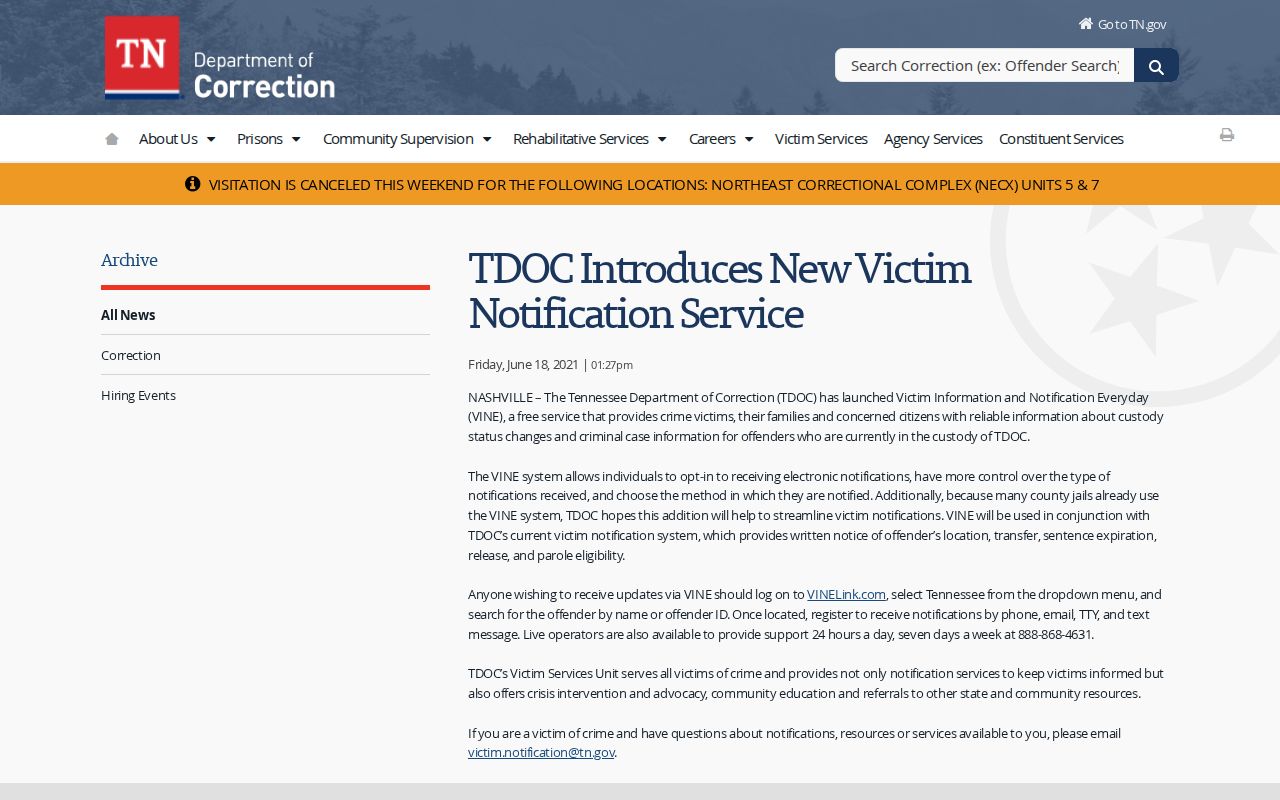
The state service image supports the notification route, while FOIL remains the better public source for reading current TDOC status and Sentence End Date in context.
If VINE reports release but FOIL still says incarcerated, note the access time for both and contact the reporting agency. If FOIL says parole, that indicates release to community supervision more strongly than a hearing schedule or grant alone. If it says inactive with a past Sentence End Date, obtain the discharge entry for exact proof.
Obion VINELink Release Limits
VINELink is not a federal inmate locator, an Obion County certified release log, or a permanent court archive. Federal Bureau of Prisons custody requires the BOP locator, and a U.S. Marshals Service prisoner may not appear there until BOP assignment. Immigration custody requires the official ICE locator when there is a factual reason to check it. No primary source established a routine Obion ICE detention program.
Contributor updates can lag. Entries can also be hard to find because of spelling, retention, identity mismatches, or a change in custody. A release notice is valuable near-real-time evidence, but the jail controls its release entry, TDOC controls its state release and discharge records, and the court controls its orders. The county records policy supplies the formal local request route, while the Obion County released inmate search path shows how those sources can be reconciled for a named person.
Keep a dated copy of the event if the timing matters. Ask Obion County Jail for the actual release date, time, and disposition, or ask TDOC for the state record. That step turns a time-sensitive notification into a source-based verification.
The court record answers a different question. An Obion bond order, dismissal, time-served judgment, or probation order can explain the legal basis for custody to end. It does not prove the moment the person walked out or rule out a second hold. VINE Courts may report the case event, custody VINE may report the jail event, and the Sheriff's release entry supplies the direct local record. Preserve all three labels when they differ.
Registry information is also separate. Tennessee's registry applies only to people legally required to register and is not a general released-person list. A qualifying community entry can sometimes corroborate post-custody presence, but it cannot provide the exact Obion release date. The agency listed on the registry record handles corrections to that record, while the jail remains responsible for its custody history.